Advanced Excel Power Query Tutorial: Automate Data Cleaning & Reporting
Mastering Advanced Power Query: Stop Copy-Pasting and Automate Everything
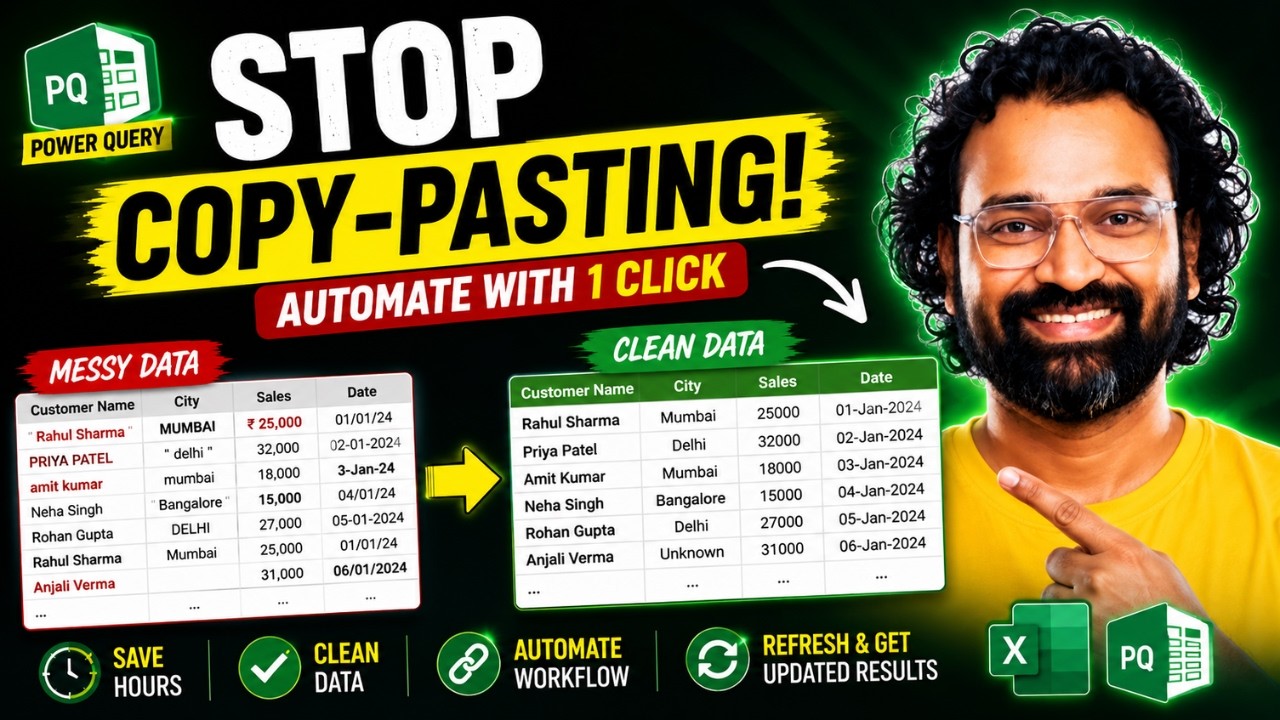
Excel remains an undeniably amazing, foundational anchor tool inside modern business infrastructure. Let's be entirely honest: most enterprise professionals spend a vast majority of their operational hours setting up, sanitizing, and preparing raw datasets rather than extracting high-level insights or executing deep analytics. Fortunately, optimized processes mean it doesn't have to be that way anymore.
Today, we highlight a high-value data skill implemented by global financial and business analytics professionals to structurally automate repetitive reporting schedules and eliminate transactional manual overhead. The primary objective is to make routine organizational work dramatically faster, contextually consistent, and fully reliable.
The Real-World Scenario: Confronting Messy Raw Systems
Every operational month, corporate analysts receive massive tables derived directly from fractured environments. Instead of dedicating hours to step-by-step cleaning routines, standard practices dictate passing these components through an automated Power Query pipeline. Raw data streams commonly contain formatting issues, irregular structural gaps, inconsistent spatial margins, hidden elements, and broken data parameters.
To initialize the pipeline, target data maps must convert cleanly into a structured system template via table parameters. Once encapsulated, this engine ports straight into the unified Power Query core processing interface, tracking every analytical edit recursively as a distinct backend code modification step.
Advanced Transformation: Columns, Cleaning & Conditions
Within the analytical window, multiple formatting scripts run concurrently. Applying explicit cleaning arrays strips out hidden system symbols, non-breaking formatting markers, and legacy ERP spaces that often disrupt lookups. Text objects normalize quickly using case conversion workflows, which preserve correct presentation layers across custom names and structural classifications.
Furthermore, processing routines evaluate database gaps dynamically. Wherever system exceptions occur, replacement logic automatically changes null pointers into standardized database zeros or pre-defined fallback targets. This approach effectively keeps critical calculations clean and functional before the target structural records map back into native Excel views.


Comments