How AI-Driven Excel is Reshaping Supply Chain Logistics
The $1.5 Trillion Inefficiency: How AI-Driven Excel is Reshaping Supply Chain Logistics
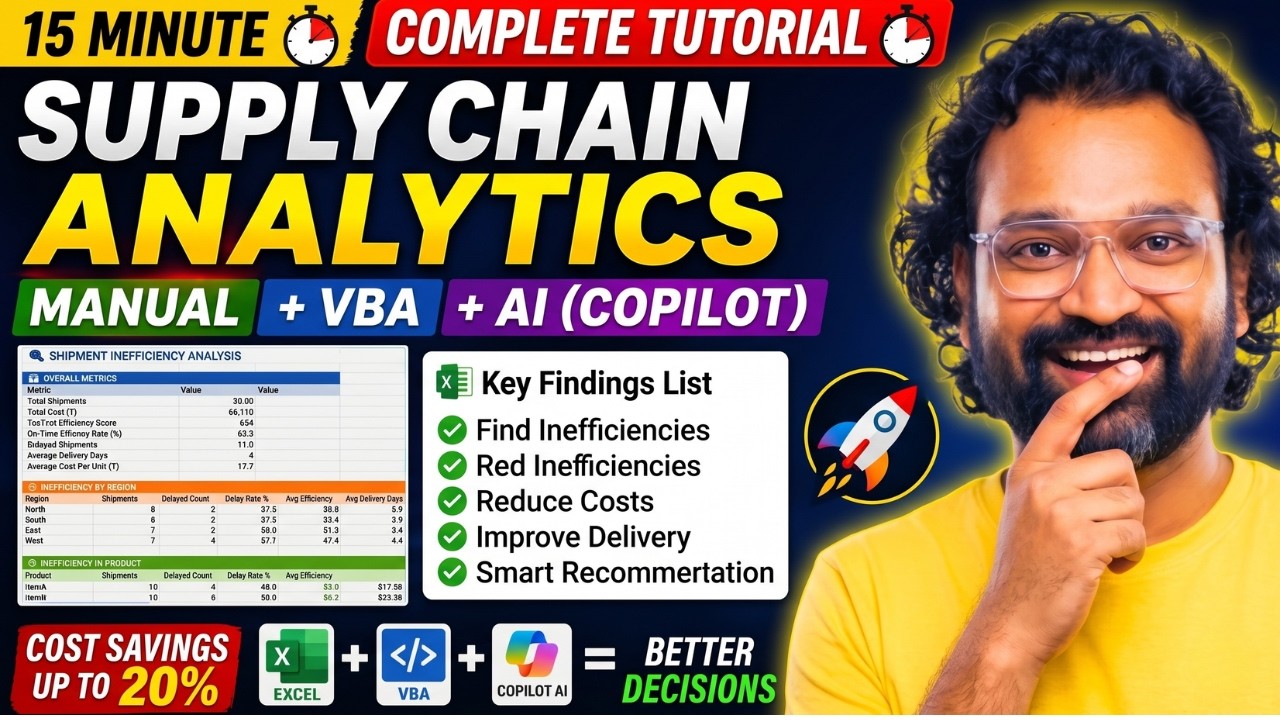
In today’s hyper-connected economy, the difference between a market leader and a casualty is often hidden in a spreadsheet. While CEOs chase the next "big thing" in Silicon Valley, the real revolution is happening within the tool every business already owns: Microsoft Excel.
The Invisible Drain on Global Margins
Supply chain leaders are currently battling a "data-rich, insight-poor" crisis. According to industry benchmarks, over 60% of logistics costs are inflated by hidden inefficiencies—delayed shipments, sub-optimal routing, and poor unit cost tracking. The problem isn't a lack of data; it's the speed of analysis.
Enter the AI-Enhanced Spreadsheet
The convergence of AI and Excel—specifically through Copilot and advanced automation—has democratized high-level data science. Companies are no longer waiting for quarterly reports to identify friction. They are doing it in real-time by:
- Hyper-Localization: Pinpointing high-cost regions with surgical precision.
- Predictive Performance: Analyzing delivery scores before they impact the customer experience.
- Automated Cost Mitigation: Identifying the exact moment shipment costs exceed unit profitability.
Executive Resources
Access our proprietary framework for integrating AI into your existing logistics workflow.
View Full Strategy GuideFrom Reactive to Proactive: The Step-By-Step Pivot
Transformation begins with data hygiene. By utilizing advanced Text Import and structuring protocols, firms are turning chaotic datasets into clean, actionable intelligence. The result? A self-healing supply chain where formulas calculate Efficiency Scores instantly, allowing managers to pivot before a delay becomes a deficit.
The Bottom Line
The future of logistics isn't just about moving goods; it's about moving information. As AI continues to integrate into the Excel ecosystem, the barriers to entry for complex supply chain optimization have vanished. The only remaining question is: how quickly can your organization adapt?


Comments